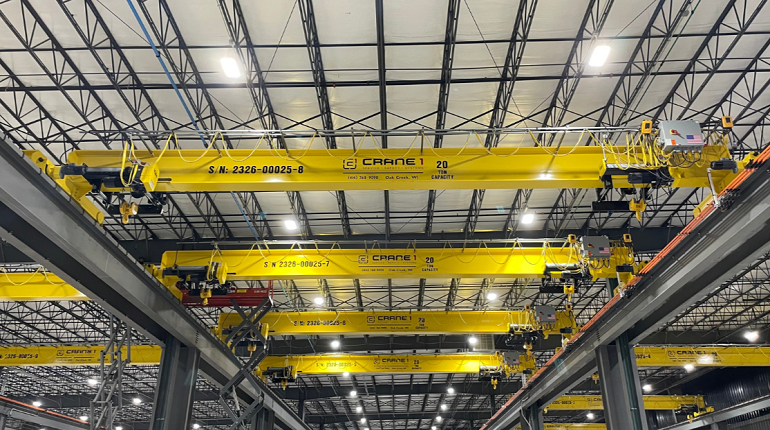
Top 5 Predictive Maintenance Innovations in the Overhead Crane Industry/h4>
Top 5 Innovations in Predictive Maintenance for Overhead Cranes
1. Advanced Sensor Technologies — The Foundation of Data-Driven Maintenance
A wide array of modern sensors continuously monitor crane health:
-
Vibration sensors detect misalignments, bearing wear, and imbalances.
-
Temperature sensors identify hot spots caused by friction or electrical issues.
-
Acoustic emission sensors (“listening like a stethoscope”) capture ultrasonic signals from cracks or structural issues.
-
Oil debris sensors analyze lubricant for wear particles from gears and bearings.
-
Current signature analysis sensors monitor motor and drive electrical patterns to flag insulation or rotor faults.
Together, these sensors enable highly accurate early diagnostics across mechanical and electrical domains.
2. AI & Machine Learning — Smarter Insights from Sensor Data
With sensor data flowing in, AI and ML algorithms turn raw inputs into predictive intelligence:
- Anomaly detection uncovers deviations from learned “normal” behavior.
- Fault diagnosis links specific data patterns to known issues, streamlining troubleshooting.
- Remaining Useful Life (RUL) estimation helps forecast component wear and schedule replacements proactively.
- These models grow more effective with continued data, optimizing Crane uptime and maintenance efficiency.
3. Industrial IoT (IIoT) — Connectivity that Empowers
IIoT platforms bridge sensors, dashboards, and teams:
-
Real-time monitoring via centralized dashboards enables instant visibility into crane performance.
-
Remote monitoring eliminates the need for constant on-site inspections.
-
Automated alerts notify teams when readings cross critical thresholds, prompting swift action.
This connectivity transforms maintenance from reactive to proactive and collaborative.
4. Digital Twins — Virtual Testing Grounds for Reality
Digital twins are dynamic virtual replicas constructed from sensor, design, and operational data:
-
They support predictive modeling, simulating how cranes respond under different conditions.
-
Offer what-if analysis, allowing safe exploration of maintenance strategies before real-world implementation.
-
Facilitate optimized planning, so maintenance can be scheduled at the most effective time, cutting unnecessary downtime. Crane1American Crane & Equipment Corporation
5. Augmented Reality (AR) & Wearables — Frontline Work Made Smarter
AR and wearable tech empower maintenance crews with:
-
In-situ visual guidance, overlaying data, instructions, and diagrams onto a technician’s field of view.
-
Remote expertise, via live video feeds that allow experts to guide and troubleshoot from afar.
-
Hands-free operations, using voice or gesture control for safety and efficiency.
This technology reduces errors, speeds repairs, and improves workplace safety.
Broader Industry Context
Beyond Crane1, other sources reinforce or expand these innovations:
-
Digital Retrofitting & Lifecycle Optimization: Smart sensor upgrades on existing crane fleets have led to up to 30% fewer unplanned outages, 20% longer service intervals, and 25% improved efficiency—especially impactful in emerging-market operations like Indian ports.
-
Triggered Vibration Readings: IoT systems like KCF’s enable vibration data collection based on operational state (not time), reducing false alerts and improving component health trend analysis.
-
Smart Service Panels: These embedded systems self-diagnose equipment status, recommend maintenance tasks, and support remote monitoring—guiding decision-making more intelligently.
-
Augmented Maintenance Trends: Broader maintenance landscapes confirm the growing role of IIoT + AI, remote diagnostics, and AR/VR in modern crane upkeep.
Summary Table
| Innovation Area | What It Delivers |
|---|---|
| Advanced Sensors | Real-time, multispectral fault detection |
| AI & ML Analytics | Predictive insights, anomaly detection, RUL |
| IIoT Connectivity | Dashboard visibility, alerts, remote intervention |
| Digital Twins | Simulated testing for optimized maintenance |
| AR & Wearables | Hands-free guidance and remote expert collaboration |
Why These Innovations Matter
Combining these technologies shifts crane maintenance from reactive patch-ups to proactive asset care. This evolution leads to:
-
Minimised downtime
-
Extended equipment life
-
Enhanced safety and operational reliability
-
Strategic and cost-effective maintenance scheduling
Want to go deeper—like examples of AI platforms for risk modeling, or which AR devices are best suited for industrial maintenance workflows? Let me know, and I’ll tailor the next level of detail!
.